The landscape of manufacturing is undergoing a profound transformation, driven by an relentless pursuit of greater efficiency, adaptability, and sustainability. At the heart of this evolution lies innovation in production line design. For decades, production lines have been the backbone of industrial output, but the future demands a more intelligent, interconnected, and dynamic approach. This article will delve into the groundbreaking trends and technologies reshaping how goods are made, from the factory floor to global supply chains.
Table of Contents
- Introduction
- AI and Advanced Automation: The Core of Future Innovation
- Digital Twins and Simulation: Virtualizing Production Excellence
- Modular and Flexible Production Systems
- Sustainability and Circular Economy Integration
- Human-Robot Collaboration (Cobots)
- The Future is Now: Embracing Smart Production
AI and Advanced Automation: The Core of Future Innovation
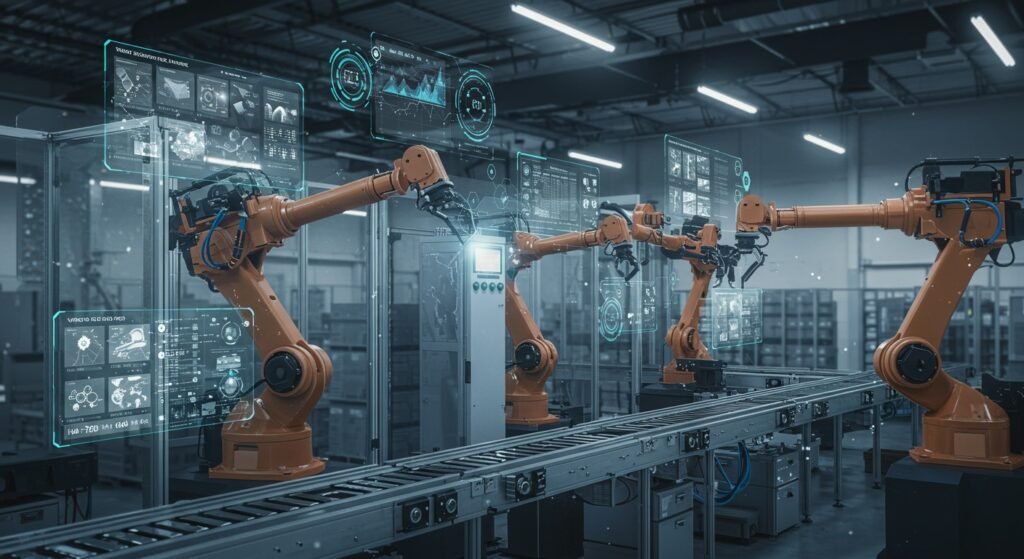
Artificial Intelligence (AI) and advanced robotics are no longer concepts confined to science fiction; they are actively revolutionizing production lines. AI algorithms optimize everything from predictive maintenance schedules to real-time quality control, minimizing downtime and waste. Robotic process automation (RPA) handles repetitive tasks with unparalleled precision and speed, freeing human workers for more complex, cognitive roles. The integration of machine learning allows systems to learn and adapt, continuously improving efficiency and throughput without constant human intervention. This era of smart automation is fostering unprecedented levels of productivity.

Digital Twins and Simulation: Virtualizing Production Excellence
A digital twin is a virtual replica of a physical production line, process, or product. This sophisticated technology allows manufacturers to simulate, analyze, and optimize operations in a virtual environment before implementing changes in the real world. By creating a digital twin, companies can predict potential bottlenecks, test new configurations, and even train AI systems, drastically reducing risks and development costs. Real-time data from sensors on the physical line feeds into the digital twin, ensuring its accuracy and providing actionable insights for continuous improvement. This virtual prototyping is a cornerstone of modern production line innovation.
Modular and Flexible Production Systems
The days of rigid, fixed production lines are fading. The market demands customization, personalization, and rapid response to changing consumer tastes. This has given rise to modular and flexible production systems. These lines are designed with interchangeable components and reconfigurable layouts, allowing manufacturers to quickly switch between different products or product variants with minimal downtime. Agility becomes a competitive advantage, enabling companies to adapt to fluctuating demand and introduce new products to market at an accelerated pace. This approach drastically reduces the capital expenditure on entirely new lines for each product type.
Sustainability and Circular Economy Integration
Beyond efficiency and speed, the future of production line design is deeply intertwined with sustainability. Manufacturers are increasingly integrating principles of the circular economy, focusing on reducing waste, reusing materials, and recycling components. This involves designing production lines that can efficiently disassemble products for material recovery, utilize renewable energy sources, and minimize their carbon footprint. Innovations in materials science and manufacturing processes are also contributing, leading to lighter, more durable, and more recyclable products. For more insights into sustainable manufacturing, you might explore sustainable manufacturing trends.
Human-Robot Collaboration (Cobots)
While automation conjures images of lights-out factories, the reality is often more nuanced. Collaborative robots, or cobots, are designed to work safely alongside human operators, augmenting their capabilities rather than replacing them entirely. Cobots handle physically demanding or repetitive tasks, reducing strain on human workers, while humans provide the cognitive flexibility, problem-solving skills, and fine motor control that robots still lack. This synergy creates highly efficient and adaptable work environments, leveraging the strengths of both humans and machines. Our internal guide to factory floor efficiency further elaborates on this collaboration.
The Future is Now: Embracing Smart Production
The convergence of advanced technologies is propelling production line design into an exciting new era. From AI-driven optimization and the predictive power of digital twins to the agility of modular systems and the ethical imperative of sustainability, the future factory will be smart, interconnected, and highly responsive. Companies that embrace these innovations will not only survive but thrive in an increasingly competitive global market. The journey towards fully autonomous, intelligent production lines is ongoing, promising unprecedented levels of efficiency, customization, and environmental responsibility.
Key Technologies Shaping Future Production Lines
| Technology | Description | Impact on Production |
|---|---|---|
| Artificial Intelligence (AI) | Algorithms for optimization, predictive maintenance, quality control. | Increased efficiency, reduced downtime, enhanced quality. |
| Robotics & Cobots | Automated physical tasks, collaborative work with humans. | Higher speed, precision, safety, and adaptability. |
| Digital Twins | Virtual replicas for simulation, testing, and optimization. | Reduced development costs, faster iteration, risk mitigation. |
| IoT & Sensors | Real-time data collection from factory equipment. | Improved monitoring, data-driven decision making. |
| Additive Manufacturing | 3D printing for rapid prototyping and custom parts. | Faster product development, complex geometries, on-demand production. |