Applications of the Fourth Industrial Revolution: Transforming Our World
The Fourth Industrial Revolution (4IR), often referred to as Industry 4.0, is fundamentally changing the way we live, work, and interact. Characterized by a fusion of technologies that blur the lines between the physical, digital, and biological spheres, its applications are vast and varied, impacting every major sector. From intelligent factories to personalized healthcare, the reach of 4IR is unprecedented, promising efficiency, innovation, and new forms of societal interaction. This article delves into the core components of this revolution and explores its most significant real-world applications.

Table of Contents
- Understanding the Fourth Industrial Revolution
- Key Applications Across Industries
- The Impact of Industry 4.0 Applications
- Conclusion
Understanding the Fourth Industrial Revolution
The Fourth Industrial Revolution builds upon the advancements of the third (digital) revolution, integrating technologies like Artificial Intelligence (AI), the Internet of Things (IoT), big data analytics, blockchain, robotics, and additive manufacturing. Unlike previous industrial revolutions that focused on mechanization, mass production, or digital automation, 4IR emphasizes connectivity, intelligence, and autonomy. This interconnectedness allows for unprecedented levels of data collection, analysis, and automated decision-making, leading to systems that are not just efficient but also adaptive and predictive. Understanding its foundational principles is crucial to appreciating the breadth of its practical applications.
Key Applications Across Industries
The true power of the Fourth Industrial Revolution lies in its diverse applications. These transformative uses are reshaping industries, creating new business models, and improving daily life.
Smart Manufacturing and Industry 4.0
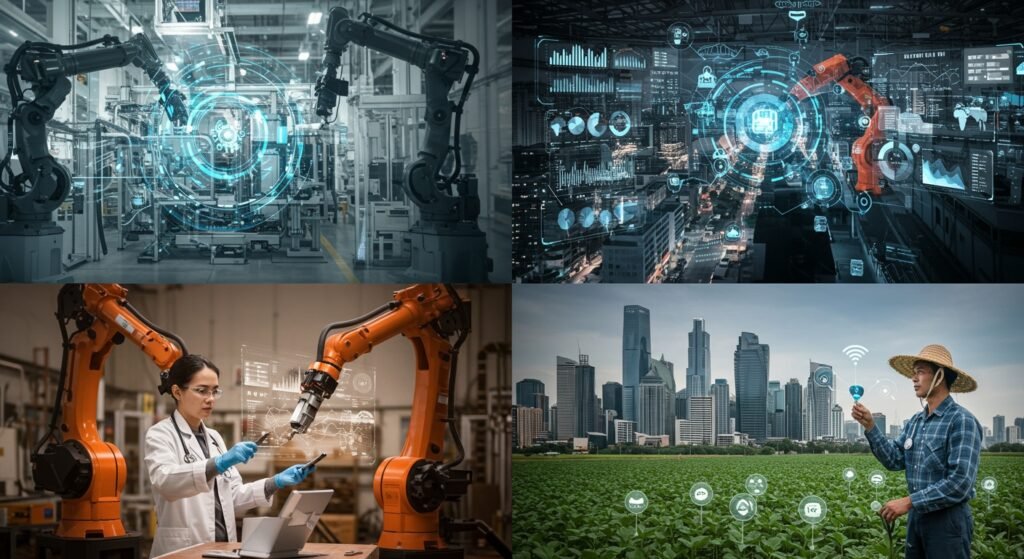
Perhaps the most widely recognized domain for 4IR is smart manufacturing, often directly referred to as Industry 4.0. Factories are becoming “smart” through the deployment of IoT sensors, AI-driven analytics, and advanced robotics. Predictive maintenance reduces downtime, optimized production lines increase efficiency, and customized manufacturing becomes economically viable. Digital twins allow for virtual simulations of physical processes, enabling engineers to test and refine designs without physical prototypes. This leads to higher quality, faster production cycles, and significant cost savings.
Healthcare Transformation
In healthcare, 4IR applications are paving the way for personalized medicine, enhanced diagnostics, and remote patient care. Wearable devices and IoT sensors continuously monitor vital signs, providing real-time data to healthcare providers. AI algorithms assist in diagnosing diseases earlier and more accurately, while machine learning helps in drug discovery and personalized treatment plans. Robotic surgery, telehealth platforms, and blockchain for secure patient records are just a few examples of how technology is improving patient outcomes and healthcare accessibility. For more insights into how AI specifically is changing medicine, you can read this WHO report on AI in Health.
Smart Cities and Infrastructure
Cities worldwide are leveraging 4IR technologies to become more efficient, sustainable, and livable. IoT networks manage traffic flow, optimize energy consumption, and improve public safety. Smart grids balance electricity supply and demand, while intelligent waste management systems reduce environmental impact. Data analytics helps urban planners make informed decisions, leading to better public services and infrastructure development. From intelligent streetlights to autonomous public transport, smart city applications enhance urban living.
Revolutionizing Agriculture
Precision agriculture, powered by IoT, AI, and drones, is transforming farming. Sensors collect data on soil moisture, nutrient levels, and crop health, enabling farmers to apply water, fertilizers, and pesticides precisely where and when needed. Drones monitor vast fields, identify problem areas, and even perform tasks like seeding. This leads to higher yields, reduced resource consumption, and more sustainable farming practices, addressing global food security challenges. Explore how these innovations are shaping the future of farming technology.
Logistics and Supply Chain Optimization
The global supply chain is becoming more transparent and efficient through 4IR technologies. Blockchain ensures secure and traceable transactions, preventing fraud and improving accountability. AI optimizes route planning and inventory management, while autonomous vehicles and drones streamline last-mile delivery. IoT sensors track goods in transit, providing real-time information on their location and condition. These applications result in reduced operational costs, faster delivery times, and greater resilience against disruptions.
The Impact of Industry 4.0 Applications
The widespread applications of the Fourth Industrial Revolution are creating profound impacts across society. Economically, they drive productivity growth, foster innovation, and create new industries and jobs, though they also necessitate workforce reskilling. Environmentally, they offer solutions for resource optimization and sustainability. Socially, they promise improved quality of life through better healthcare, smarter cities, and more efficient services. However, challenges such as data security, ethical AI development, and digital divides must be addressed to ensure equitable and beneficial progress for all.
Examples of Industry 4.0 Applications
| Sector | Key Technology | Application Example | Benefit |
|---|---|---|---|
| Manufacturing | IoT, AI, Robotics | Predictive maintenance of machinery | Reduced downtime, increased efficiency |
| Healthcare | AI, Wearables | Personalized drug dosage via real-time data | Improved patient outcomes, tailored treatment |
| Agriculture | IoT, Drones | Precision irrigation based on soil sensors | Water conservation, optimized crop yield |
| Logistics | Blockchain, AI | Transparent and traceable supply chains | Reduced fraud, enhanced trust |
| Urban Planning | IoT, Big Data | Smart traffic management systems | Reduced congestion, lower emissions |
Conclusion
The Fourth Industrial Revolution is not merely a technological shift but a transformative force redefining industries and societies. Its diverse applications, from intelligent factories and precision agriculture to smart cities and personalized healthcare, underscore its immense potential. By embracing these innovations thoughtfully and addressing the associated challenges, we can harness the power of 4IR to build a more efficient, sustainable, and prosperous future for everyone.