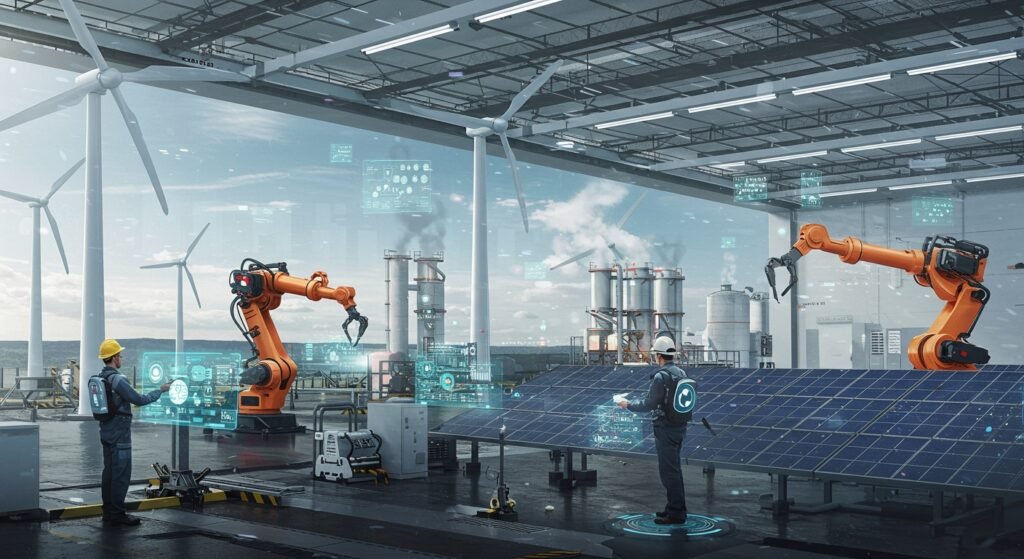
Industrial engineering is a discipline focused on optimizing complex processes, systems, and organizations. In the rapidly evolving alternative energy sector, its principles are not just beneficial but absolutely critical. From designing efficient production lines for solar panels to managing vast wind farm projects, industrial engineers bring a systematic approach to sustainability. This article explores how the Industrial application of engineering principles is revolutionizing clean energy, driving efficiency, reducing costs, and accelerating the global transition to a sustainable future.

Table of Contents
- The Fundamental Impact of Industrial Engineering in Alternative Energy
- Optimizing Manufacturing and Production Processes
- Revolutionizing Supply Chain Management and Logistics
- Core Applications and Strategic Innovations
- Project Management Excellence for Renewable Installations
- Enhancing System Design, Integration, and Reliability in the Industrial Sector
- Confronting Challenges and Paving the Way Forward
- Conclusion
The Fundamental Impact of Industrial Engineering in Alternative Energy
Industrial engineering provides invaluable methodologies for systemic improvement across various sectors, and its role in alternative energy is becoming increasingly pivotal. It’s not merely about ‘what’ we produce, but ‘how’ we produce, distribute, and consume clean energy, ensuring that these processes are as efficient and sustainable as the energy itself. This discipline offers the tools to analyze, design, and optimize the intricate systems that underpin the entire renewable energy value chain.
Optimizing Manufacturing and Production Processes
At the heart of renewable energy expansion is the efficient production of its components. Industrial engineers apply principles like Lean Manufacturing and Six Sigma to streamline the fabrication of solar panels, wind turbine blades, and battery cells. This involves identifying and eliminating waste, reducing production bottlenecks, improving quality control, and optimizing assembly lines, ultimately lowering manufacturing costs and increasing output volume.
Revolutionizing Supply Chain Management and Logistics
The global nature of alternative energy projects demands robust and efficient supply chains. Industrial engineers are crucial in designing and managing the complex logistics involved in sourcing raw materials, transporting large components (like turbine towers) to often remote installation sites, and distributing finished products. Their work minimizes lead times, reduces transportation emissions, and ensures that vital components arrive precisely when needed, preventing costly delays in project timelines.
Core Applications and Strategic Innovations
Beyond manufacturing and logistics, industrial engineering drives strategic innovation and execution across the alternative energy landscape.
Project Management Excellence for Renewable Installations
Large-scale renewable energy projects, such as utility-scale solar farms, offshore wind parks, or geothermal power plants, are incredibly complex endeavors. Industrial engineers are adept at project planning, scheduling, resource allocation, and risk management. They ensure that these multi-million or even multi-billion dollar projects are completed on time and within budget, coordinating diverse teams and managing intricate interdependencies. Their expertise is vital in scaling up renewable infrastructure globally.
Industrial Engineering Impact Areas
| Area of Impact | Key Contribution | Example Application |
|---|---|---|
| Efficiency | Process Optimization | Lean manufacturing for solar panels |
| Cost Reduction | Waste Elimination | Optimizing wind turbine component transport |
| Reliability | Quality Control & Maintenance | Predictive maintenance for energy grids |
| Scalability | System Design | Scaling battery storage solutions |
Enhancing System Design, Integration, and Reliability in the Industrial Sector
Industrial engineers play a pivotal role in designing integrated energy systems, ensuring grid stability as more intermittent renewable sources come online. They focus on aspects like energy storage integration, smart grid development, and demand-side management. Quality control, predictive maintenance, and overall system reliability are paramount, especially for Industrial applications that require constant uptime and robust performance. Understanding system vulnerabilities and designing redundancies are key contributions. Learn more about sustainable practices.
Confronting Challenges and Paving the Way Forward
The alternative energy sector faces ongoing challenges, including scalability of solutions, grid modernization, and the need for more efficient energy storage. Industrial engineers are at the forefront of addressing these issues by applying advanced analytics, simulation modeling, and artificial intelligence to predict failures, optimize operations, and design resilient systems. Their continuous pursuit of efficiency and innovation will be crucial as the world pushes towards greater energy independence and sustainability. For further reading on industrial engineering innovations, visit IES website.
Conclusion
The synergy between industrial engineering and alternative energy is undeniable. Industrial engineers are not just supporting the transition to clean energy; they are actively shaping its future by making it more efficient, reliable, and economically viable. Their systematic approach to problem-solving and optimization is an indispensable asset in the global effort to build a sustainable energy landscape for generations to come.