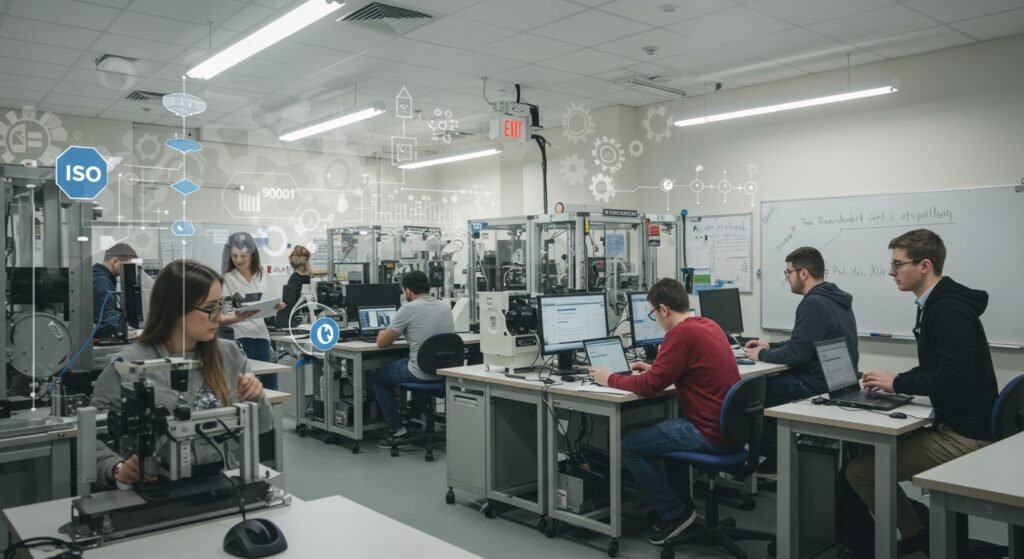
Industrial engineering is at the forefront of optimizing complex systems. To thrive, professionals need more than theoretical knowledge; they require a deep understanding of global best practices. This is precisely where ISO standards play a pivotal role, fundamentally shaping the quality of education in this vital field. This article explores how these internationally recognized benchmarks enhance learning outcomes and prepare future engineers for the demands of the modern industrial landscape.

- Why ISO Standards Matter in Industrial Engineering Education
- Integrating ISO Standards into Curriculum Design
- Benefits of an ISO Standards-Focused Curriculum
- Challenges and Future Prospects
Why ISO Standards Matter in Industrial Engineering Education
The industrial world is driven by efficiency, quality, and continuous improvement. Organizations globally adopt ISO standards to ensure their processes meet stringent benchmarks, reduce waste, and enhance customer satisfaction. For industrial engineers, an understanding of these standards is not merely beneficial; it’s essential. Graduates who are conversant with ISO 9001 (Quality Management), ISO 14001 (Environmental Management), or ISO 45001 (Occupational Health and Safety) possess a significant competitive advantage.
Integrating these global benchmarks into academic programs ensures that students are not just learning theories, but also practical frameworks that are directly applicable in real-world scenarios. This bridge between academia and industry demands a proactive approach to curriculum development, ensuring relevance and future-proof skills.
The Evolution of Quality Education
Historically, industrial engineering education focused heavily on core principles like operations research, manufacturing processes, and supply chain management. While these remain foundational, the emphasis on systemic quality, risk management, and sustainability, largely championed by ISO standards, has grown exponentially. Modern curricula must reflect this shift, providing students with tools to implement and audit quality management systems, understand environmental impacts, and promote workplace safety—all governed by ISO frameworks.
Integrating ISO Standards into Curriculum Design
Effective integration of ISO standards into industrial engineering programs requires more than just adding a module; it necessitates weaving the principles throughout various courses. This can involve dedicated courses on quality management systems, project-based learning where students develop ISO-compliant procedures, or capstone projects focused on auditing and improving existing systems within an organization.
For instance, a course on production systems could analyze how ISO 9001 principles guide process documentation and control. Similarly, a supply chain management course could delve into how ISO 14001 influences sustainable sourcing and logistics. Experiential learning, such as internships with ISO-certified companies, further solidifies theoretical understanding into practical expertise.
Practical Applications and Case Studies
Using real-world case studies is paramount. Students can analyze scenarios where companies successfully implemented ISO standards to overcome operational challenges or failed to adhere to them, leading to costly consequences. This approach fosters critical thinking and problem-solving skills, preparing them to apply ISO standards effectively upon graduation. Simulation exercises where students act as auditors or consultants to assess hypothetical companies against ISO criteria can also be highly effective learning tools.
Benefits of an ISO Standards-Focused Curriculum
The advantages of an education steeped in ISO principles are manifold for both students and the industry. Graduates are better equipped, more adaptable, and immediately valuable to employers seeking to maintain or achieve ISO certification. This proactive approach to education ensures that future industrial engineers are not just problem-solvers but also standard-bearers for quality and efficiency.
| Feature | ISO Standards-Focused Education | Traditional Education |
|---|---|---|
| Relevance to Industry | High (Directly applicable global benchmarks) | Moderate (Foundational theories) |
| Practical Skills | Strong (System implementation, auditing) | Varies (More theoretical) |
| Career Prospects | Enhanced (In-demand certifications) | Standard |
| Global Competitiveness | Excellent (International recognition) | Good |
| Continuous Improvement Mindset | Integrated | Often supplementary |
Moreover, institutions that incorporate these standards into their curriculum enhance their own reputation, attracting high-caliber students and fostering stronger ties with industries that value these certifications. It’s a win-win scenario, cultivating a workforce that is not only skilled but also globally aware and compliant.
Challenges and Future Prospects
Despite the clear benefits, integrating ISO standards into industrial engineering education is not without its challenges. Keeping curricula updated with the latest revisions of standards, securing experienced faculty who possess practical auditing or implementation experience, and allocating resources for relevant software and tools are significant hurdles. Furthermore, there’s a need to balance the depth of theoretical knowledge with the breadth of practical application.
The future, however, looks promising. As industries become even more globalized and interconnected, the demand for professionals proficient in international standards will only intensify. Education programs must continue to evolve, possibly incorporating new standards related to artificial intelligence, cybersecurity in industrial systems, or advanced sustainability metrics. Learning more about modern industrial optimization techniques can complement this knowledge. For further reading on developing a robust curriculum, consider exploring our Curriculum Development Best Practices resource.
In conclusion, the integration of ISO standards into industrial engineering education is not merely an enhancement; it’s a necessity for producing globally competent and highly effective professionals. By providing a framework for quality, safety, and environmental responsibility, these standards elevate the learning experience, ensuring that graduates are not only skilled engineers but also responsible leaders capable of driving continuous improvement in any industrial setting. Embracing ISO standards today is investing in the quality education of tomorrow’s industrial leaders.