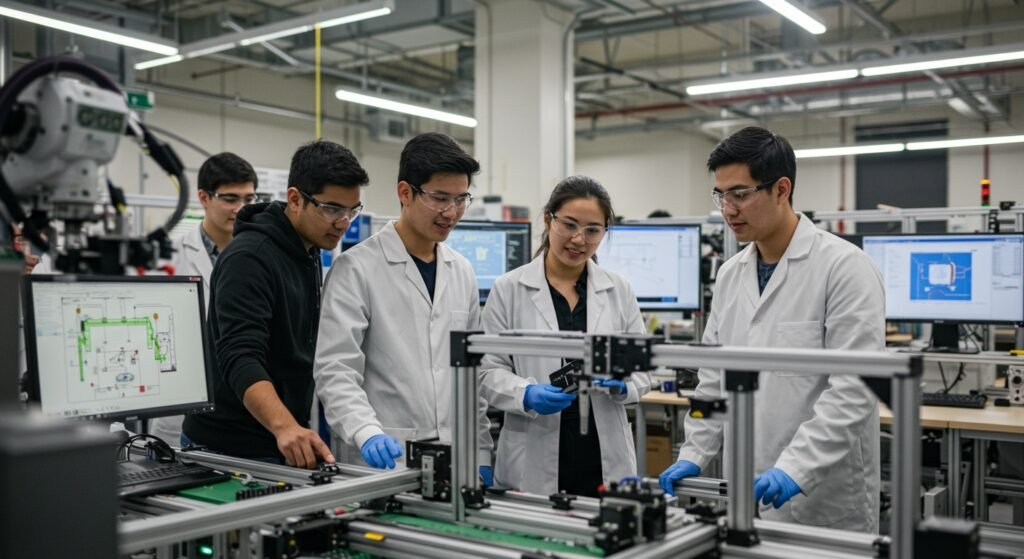
Embarking on a Bachelor of Science (BSc) in Manufacturing Systems Engineering opens doors to an exciting and dynamic field. This degree equips students with the foundational knowledge and practical skills needed to design, optimize, and manage complex manufacturing processes. At its heart, understanding the manufacturing basics is paramount. It’s not just about producing goods; it’s about doing so efficiently, sustainably, and cost-effectively, ensuring quality at every step.
Modern industry demands engineers who can bridge the gap between theoretical knowledge and real-world application. A BSc in Manufacturing Systems Engineering focuses on integrating people, materials, information, equipment, and energy to create value. This article will delve into the essential components of this degree, highlighting what makes it a crucial choice for aspiring engineers in a rapidly evolving global economy.
- The Core Pillars of Manufacturing Systems Engineering
- Key Skills Developed in a BSc Program
- Career Prospects for Graduates
- Conclusion
The Core Pillars of Manufacturing Systems Engineering
The curriculum for a BSc in Manufacturing Systems Engineering is designed to provide a robust understanding of the entire manufacturing lifecycle. It goes beyond the workshop floor, encompassing design, planning, production, and distribution. Several core areas form the backbone of this specialization.
Understanding Manufacturing Basics: Processes and Principles
At the fundamental level, students are immersed in the core principles of manufacturing. This includes studying various production methods like machining, casting, forming, welding, and additive manufacturing. Emphasis is placed on understanding the material science behind these processes and how to select the most appropriate method for a given product. Furthermore, lean manufacturing and Six Sigma methodologies are introduced, teaching students how to identify and eliminate waste, reduce defects, and optimize workflows. A strong grasp of manufacturing basics is non-negotiable for any successful engineer in this field.

Quality Control and Assurance
Ensuring product quality is paramount. This pillar covers statistical process control (SPC), total quality management (TQM), and various inspection and testing techniques. Students learn to implement quality systems, conduct audits, and analyze data to prevent defects and drive continuous improvement. Understanding ISO standards and other industry-specific regulations is also a critical component.
Supply Chain Management
A manufactured product rarely comes from a single source. Students learn about the complexities of global supply chains, including logistics, inventory management, procurement, and supplier relationship management. The goal is to optimize the flow of materials and information from raw material acquisition to final product delivery, minimizing costs and maximizing efficiency. For more insights on optimizing operations, consider exploring modern lean operations strategies.
Key Skills Developed in a BSc Program
Beyond theoretical knowledge, a BSc in Manufacturing Systems Engineering cultivates a unique set of skills essential for professional success.
Problem-Solving and Analytical Thinking
Engineers in manufacturing constantly face challenges, from unexpected equipment failures to production bottlenecks. The program fosters strong analytical and problem-solving abilities, teaching students to diagnose issues, apply scientific principles, and develop innovative solutions. This often involves using simulation software and data analysis tools to model scenarios and predict outcomes.
Technology Integration and Automation
The modern manufacturing landscape is defined by technology. Students gain proficiency in computer-aided design (CAD) and computer-aided manufacturing (CAM), robotics, automation systems, and industrial internet of things (IIoT) applications. Understanding how to integrate these technologies to create intelligent and adaptive manufacturing systems is a core competency.
Career Prospects for Graduates
A BSc in Manufacturing Systems Engineering opens up a diverse range of career opportunities across various sectors.
Industries and Roles
Graduates can find roles in automotive, aerospace, electronics, pharmaceuticals, consumer goods, and many other industries. Typical job titles include Manufacturing Engineer, Process Engineer, Quality Engineer, Supply Chain Analyst, Production Manager, and Automation Specialist. The foundational understanding of industrial engineering careers and manufacturing processes provides a competitive edge in a global job market.
Here’s a comparison of characteristics between traditional and modern manufacturing approaches:
| Characteristic | Traditional Manufacturing | Modern Manufacturing |
|---|---|---|
| Production Volume | Mass production, less customization | Flexible, mass customization possible |
| Technology Use | Manual labor, basic machinery | Automation, robotics, AI, IIoT |
| Efficiency Focus | Cost reduction, high output | Waste reduction, quality, sustainability |
| Supply Chain | Linear, less integrated | Interconnected, global, transparent |
| Decision Making | Experience-based, reactive | Data-driven, proactive, predictive |
Conclusion
A BSc in Manufacturing Systems Engineering offers an invaluable pathway to a rewarding career in an essential global industry. By thoroughly grounding students in manufacturing basics, alongside advanced concepts in quality, supply chain, and automation, the program produces versatile engineers ready to tackle the challenges of modern production. The demand for skilled professionals who can innovate and optimize manufacturing processes continues to grow, making this degree a strategic investment in one’s future. Graduates are well-prepared to lead the next generation of industrial advancement, shaping how products are made and delivered worldwide.