Sustainable Manufacturing: Research Topics for PhD Candidates

The global industrial landscape is rapidly shifting towards more environmentally conscious and socially responsible practices. At the forefront of this transformation is the concept of sustainable manufacturing, a paradigm that seeks to minimize negative environmental impacts while conserving energy and natural resources, ensuring employee, community, and product safety, and remaining economically sound. For aspiring academics and industry innovators, pursuing a PhD in this dynamic field offers unparalleled opportunities to contribute to real-world solutions. This article delves into crucial research topics that PhD candidates can explore to drive industrial innovation and create a greener future.
Table of Contents
- The Urgency of Sustainable Manufacturing Research
- Key Research Areas in Sustainable Manufacturing for PhD Candidates
- Interdisciplinary Approaches and Future Trends
- Embarking on Your Sustainable Manufacturing PhD Journey
The Urgency of Sustainable Manufacturing Research
The imperative for sustainable manufacturing has never been greater. Faced with escalating environmental challenges like climate change, resource depletion, and burgeoning waste streams, industries are under immense pressure to reform their operations. Consumers are increasingly demanding eco-friendly products, while stringent regulations compel businesses to adopt greener practices. Beyond compliance, embracing sustainability offers economic benefits through reduced operational costs, enhanced brand reputation, and access to new markets. However, the transition is complex, requiring innovative solutions that only rigorous academic research can provide. PhD candidates are uniquely positioned to bridge the gap between theoretical models and practical, scalable industrial applications.
Key Research Areas in Sustainable Manufacturing for PhD Candidates
PhD candidates have a critical role to play in advancing the methodologies and applications within sustainable manufacturing. Here are some promising avenues for in-depth study:
Life Cycle Assessment and Eco-Design
Research in this area focuses on evaluating the environmental impacts of a product throughout its entire life cycle, from raw material extraction to disposal. PhD projects could involve developing more robust LCA methodologies, integrating social and economic aspects into life cycle sustainability assessments (LCSA), or creating AI-driven tools for eco-design optimization. Understanding the true footprint of products is fundamental to making informed design and production decisions.
Circular Economy Implementation
The transition from a linear “take-make-dispose” model to a circular economy is fundamental to sustainable manufacturing. Research could explore novel business models for product-as-a-service, advanced recycling technologies, remanufacturing processes, or the systemic challenges and opportunities in implementing circularity across different industrial sectors. This includes investigating material loops, waste-to-resource strategies, and fostering industrial symbiosis.
Advanced Materials and Processes
Investigating the development and application of sustainable materials (e.g., bioplastics, recycled composites, self-healing materials) and green manufacturing processes (e.g., additive manufacturing with sustainable feedstock, solvent-free processes, bio-fabrication) presents significant research opportunities. This includes studies on material characterization, process optimization for reduced waste, energy consumption, and toxicity, contributing directly to a cleaner production cycle.
Energy Efficiency and Renewable Integration
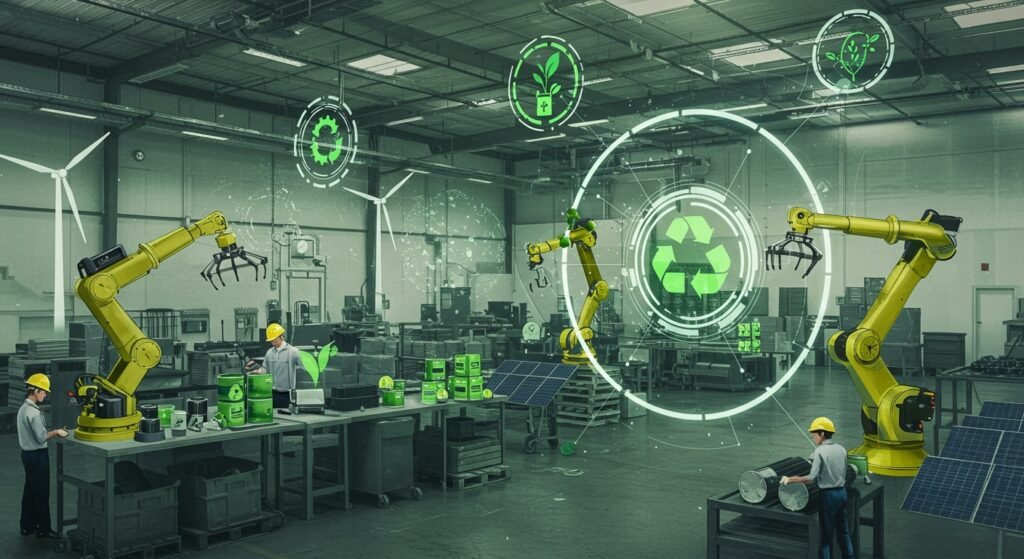
Reducing energy consumption and integrating renewable energy sources are vital for sustainable operations. PhD research could focus on smart energy management systems in factories, optimizing manufacturing processes for minimal energy use through advanced controls, developing energy harvesting technologies, or exploring grid integration challenges for industrial renewable energy. The goal is to create factories that are not only energy-efficient but also energy self-sufficient.
Supply Chain Sustainability and Digitalization
A truly sustainable manufacturing approach extends beyond the factory gates. Research topics here include optimizing sustainable logistics, blockchain for supply chain transparency and traceability, ethical sourcing, resilience against disruptions, and the role of digital twins in simulating and optimizing sustainable supply chain networks. Ensuring sustainability across the entire value chain is crucial for genuine impact.
Social and Ethical Dimensions
Sustainability is not just environmental; it also encompasses social equity and ethical governance. PhD research can delve into fair labor practices, community engagement, occupational health and safety in green industries, the ethics of automation in sustainable factories, or the societal impacts of transitioning to a circular economy. These aspects are critical for a holistic approach to industrial sustainability.
To illustrate the varying impacts of different sustainability focus areas, consider the following comparative table:
| Research Area | Primary Impact | Complexity Level | Key Technologies/Methods |
|---|---|---|---|
| Life Cycle Assessment | Environmental Footprint Reduction | Medium to High | LCA Software, Data Analytics, Standards (ISO 14040/44) |
| Circular Economy | Resource Efficiency, Waste Reduction | High | Remanufacturing, Recycling, Product-as-a-Service Models |
| Advanced Materials | Reduced Resource Use, Eco-friendliness | High | Material Science, Green Chemistry, Additive Manufacturing |
| Energy Efficiency | Reduced Emissions, Cost Savings | Medium | Smart Grids, Energy Auditing, Process Optimization |
Interdisciplinary Approaches and Future Trends
The most impactful research often lies at the intersection of disciplines. PhD candidates should consider interdisciplinary projects combining engineering with economics, policy, social sciences, or data science. Emerging trends such as Industry 5.0, AI for sustainability, advanced robotics, and bio-inspired manufacturing offer fertile ground for novel research questions. Understanding how to integrate these advancements is key for future industrial innovation. For more insights on integrating technology, you might find this external resource on sustainable industrialization useful. Also, check out our insights on Eco-Friendly Materials in Manufacturing for related content.
Embarking on Your Sustainable Manufacturing PhD Journey
A PhD in sustainable manufacturing is more than an academic pursuit; it’s a commitment to shaping a better future. Prospective candidates should identify a specific problem, align with a supervisor whose expertise matches their interests, and develop a robust research proposal. The journey is challenging but immensely rewarding, offering the chance to innovate, publish, and become a leader in the global push for a sustainable industrial paradigm. Your research can be the catalyst for transformative change, paving the way for industries that thrive in harmony with the planet and society.