Process Optimization in Hospitals Using Industrial Engineering Tools
In today’s complex healthcare landscape, achieving operational excellence is paramount. Hospitals face immense pressure to deliver high-quality patient care while managing costs and resources effectively. This is where process optimization, leveraging robust industrial engineering tools, becomes a game-changer. By systematically analyzing and improving workflows, hospitals can enhance efficiency, reduce wait times, and ultimately elevate the patient experience. This article explores how industrial engineering principles can transform hospital operations, driving significant improvements across various departments.
Table of Contents
- What is Industrial Engineering in Healthcare?
- Key Industrial Engineering Tools for Hospitals
- Benefits of Process Optimization in Healthcare
- Implementing IE: Strategies and Challenges
- Conclusion

What is Industrial Engineering in Healthcare?
Industrial Engineering (IE) is a discipline focused on optimizing complex processes, systems, and organizations. Traditionally applied in manufacturing, its principles are highly transferable to service industries like healthcare. In a hospital setting, IE involves analyzing patient journeys, staff workflows, resource allocation, and facility layouts to identify inefficiencies and bottlenecks. The goal is to design and implement improved systems that enhance efficiency, safety, quality, and cost-effectiveness without compromising patient care.
Unlike other engineering disciplines that deal with physical products, industrial engineers in healthcare deal with the flow of patients, information, and materials. They apply a scientific approach to problem-solving, using data to understand current state performance, model potential improvements, and measure the impact of changes. This data-driven approach is critical for sustainable improvements in hospital operations.
Key Industrial Engineering Tools for Hospitals
Several industrial engineering tools have proven particularly effective in healthcare settings. These tools provide a structured methodology for identifying, analyzing, and resolving operational issues.
Lean Six Sigma
Lean Six Sigma combines two powerful methodologies: Lean, which focuses on eliminating waste (e.g., waiting, overproduction, defects), and Six Sigma, which aims to reduce variation and improve quality by minimizing errors. In hospitals, Lean Six Sigma can be applied to diverse areas such as emergency department throughput, surgical suite scheduling, medication administration, and discharge processes. By streamlining these processes, hospitals can achieve faster service, fewer errors, and greater patient satisfaction.
Value Stream Mapping
Value Stream Mapping (VSM) is a visual tool used to illustrate, analyze, and improve the steps required to deliver a product or service. In healthcare, VSM helps map the entire patient journey for a specific condition or service, from initial contact to discharge and follow-up. This visual representation highlights all value-adding and non-value-adding steps, making it easier to pinpoint areas of waste, delay, and rework. Once bottlenecks are identified, targeted interventions can be designed to create a more efficient and patient-centered flow.
Simulation Modeling
Simulation modeling involves creating a computer model of a real-world system to observe its behavior under different conditions. For hospitals, this means simulating patient arrivals, staff assignments, bed availability, and equipment usage to predict the impact of changes without disrupting actual operations. For example, a hospital might use simulation to test different staffing levels in the ER, evaluate the effect of adding new operating rooms, or optimize the layout of a new clinic. This proactive approach helps in making informed decisions and mitigating risks.
Queueing Theory
Queueing theory is the mathematical study of waiting lines, or queues. It provides models to predict queue lengths, waiting times, and resource utilization based on arrival rates and service rates. Hospitals can apply queueing theory to optimize patient flow in areas prone to bottlenecks, such as registration desks, radiology departments, or outpatient clinics. By understanding the dynamics of waiting lines, administrators can make better decisions about staffing, scheduling, and capacity to reduce patient wait times and improve service delivery.
Benefits of Process Optimization in Healthcare
The implementation of industrial engineering tools for process optimization yields a multitude of benefits for hospitals, impacting patients, staff, and the bottom line. From enhanced safety to significant cost savings, the improvements are far-reaching.
| Benefit Area | Description | Example Impact |
|---|---|---|
| Improved Patient Flow & Experience | Reduced wait times, smoother transitions between departments, clear communication. | 50% reduction in ED wait times; increased patient satisfaction scores. |
| Enhanced Operational Efficiency | Streamlined workflows, optimized resource allocation, reduced administrative burden. | 20% increase in surgical suite utilization; improved staff productivity. |
| Cost Reduction | Elimination of waste, optimized inventory, reduced overtime, fewer errors. | 15% reduction in supply chain costs; millions saved annually through waste reduction. |
| Better Quality & Safety | Standardized processes, reduced variation, fewer medical errors, proactive risk management. | 30% decrease in medication errors; improved compliance with safety protocols. |
| Staff Satisfaction & Retention | Reduced burnout, clearer roles, less frustration, more time for direct patient care. | Improved staff morale; lower turnover rates in high-stress departments. |
Implementing IE: Strategies and Challenges
Successfully integrating industrial engineering principles into hospital operations requires a strategic approach. It’s not just about applying tools; it’s about fostering a culture of continuous improvement.
Key strategies include:
- Leadership Buy-in: Strong support from hospital leadership is crucial for allocating resources and overcoming resistance to change.
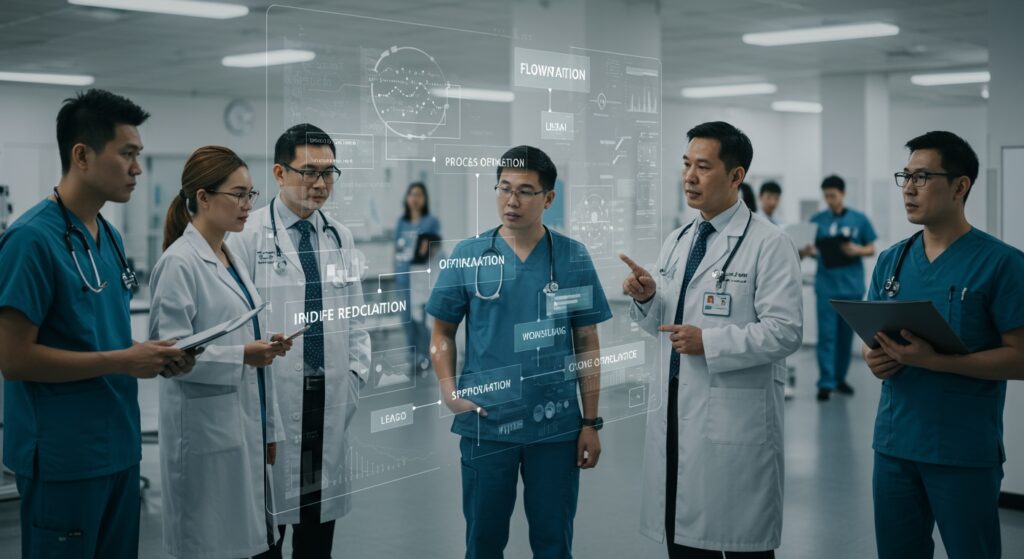
- Cross-functional Teams: Bringing together staff from different departments (doctors, nurses, administrators, IT) ensures a holistic view of processes and fosters collaborative problem-solving.
- Data-Driven Decisions: Relying on objective data rather than anecdotal evidence ensures that improvements are targeted and effective.
- Training and Education: Equipping staff with the knowledge of IE principles and tools empowers them to identify and implement improvements themselves.
- Pilot Programs: Starting with smaller, manageable projects allows hospitals to test interventions, demonstrate success, and build momentum before scaling up.
Challenges can include initial resistance from staff, the complexity of healthcare systems, and the need for sustained effort. However, the long-term benefits far outweigh these hurdles. For more insights on enhancing patient journeys, you might find our article on improving patient experience helpful.
Further resources on industrial engineering can be found at the Institute of Industrial and Systems Engineers.
Conclusion
Industrial engineering tools offer a powerful framework for driving process optimization in hospitals. By systematically tackling inefficiencies and streamlining workflows, healthcare organizations can achieve a trifecta of benefits: superior patient care, enhanced operational efficiency, and substantial cost savings. Embracing these methodologies is not merely about adapting to change; it’s about proactively shaping a more effective, patient-centered, and sustainable future for healthcare. The journey towards an optimized hospital begins with a commitment to continuous improvement and the strategic application of proven engineering principles.