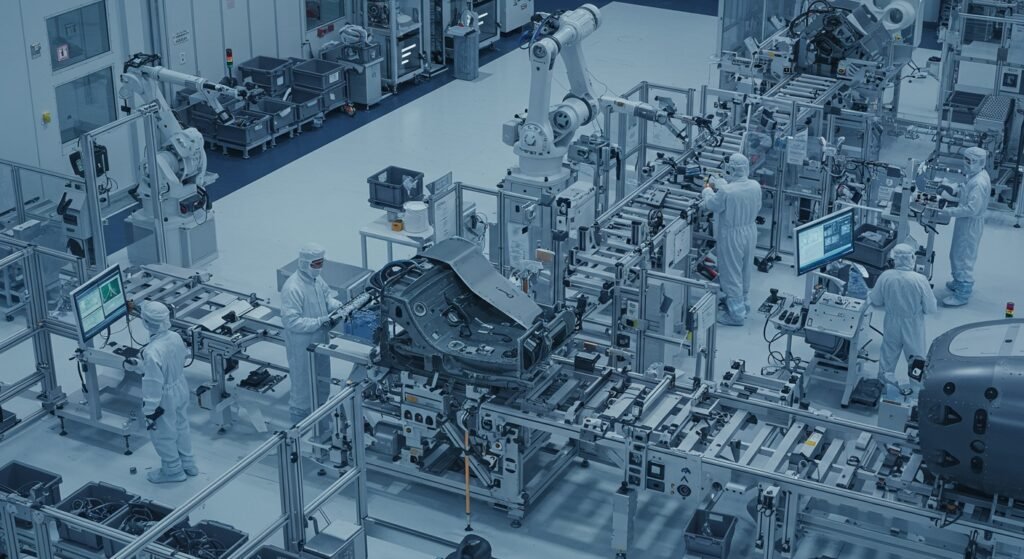
The skies above us, once a realm of pure imagination, are now meticulously navigated thanks to human ingenuity. Behind every safe flight, every efficient production line, and every advanced aircraft, lies the crucial discipline of industrial engineering. This field, focused on optimizing complex processes, plays an indispensable role in the aerospace and aviation sectors. From initial design to manufacturing, maintenance, and supply chain management, industrial engineers ensure that the highly complex and safety-critical operations of the aerospace industry run smoothly, safely, and economically.

Table of Contents
- The Intersection of Industrial Engineering and Aerospace
- Key Applications of Industrial Engineering in Aviation
- Overcoming Challenges and Future Trends in Aerospace
- The Path to a Career in Aerospace Industrial Engineering
- Conclusion
The Intersection of Industrial Engineering and Aerospace
Industrial engineering is essentially about making things better, faster, and more cost-effective, all while maintaining the highest quality and safety standards. In the context of aerospace, this means applying scientific and mathematical principles to design, develop, and implement systems that improve productivity and performance within organizations building and operating aircraft and spacecraft.
Optimizing Design and Development
Even before a single component is manufactured, industrial engineers contribute significantly to the design phase. They analyze design specifications for manufacturability, assembly sequence, and maintenance accessibility. By employing tools like simulation and process modeling, they help identify potential bottlenecks or inefficiencies early on, leading to designs that are not only functional but also practical and economical to produce.
Streamlining Manufacturing Processes
The manufacturing of aerospace components is incredibly complex, involving precision engineering, advanced materials, and stringent quality control. Industrial engineers design factory layouts, optimize workflow, and implement lean manufacturing principles to reduce waste, improve cycle times, and enhance overall productivity. This includes everything from selecting the right machinery to developing efficient assembly lines for aircraft.
Key Applications of Industrial Engineering in Aviation
The reach of industrial engineering extends across various critical functions within the aviation industry, directly impacting efficiency and reliability.
Supply Chain Management for Aerospace Components
Managing the global supply chain for aerospace parts is a monumental task. Industrial engineers develop robust systems for procurement, inventory control, and logistics to ensure that the right components are available at the right time, preventing costly delays in aircraft production or maintenance. They mitigate risks associated with supplier performance and geopolitical factors, crucial for the highly integrated aerospace ecosystem.
Quality Control and Reliability
In aerospace, there is zero tolerance for error. Industrial engineers design and implement comprehensive quality assurance programs, utilizing statistical process control and other methodologies to monitor and control manufacturing processes. Their work ensures that every component meets the highest safety and reliability standards, a non-negotiable aspect of flight. For further insights into aviation safety, you can visit resources like the Federal Aviation Administration’s website (this is an external link).
Maintenance, Repair, and Overhaul (MRO) Optimization
Aircraft require regular and extensive maintenance. Industrial engineers apply their expertise to optimize MRO operations, scheduling maintenance activities to minimize downtime, streamlining repair processes, and managing spare parts inventory effectively. This ensures aircraft spend more time in the air, generating revenue, and less time grounded for servicing.
Overcoming Challenges and Future Trends in Aerospace
The aerospace industry is constantly evolving, presenting new challenges and opportunities for industrial engineers. From integrating advanced automation to addressing environmental concerns, their role is more vital than ever.
Data Analytics and AI in Aerospace IE
The future of industrial engineering in aerospace is deeply intertwined with data analytics and artificial intelligence. Engineers are increasingly using big data to predict equipment failures, optimize flight paths, improve demand forecasting, and enhance autonomous manufacturing processes. This data-driven approach leads to smarter decisions and more resilient operations.
Impact on Efficiency and Cost Savings
| Area of Optimization | Industrial Engineering Impact | Example Benefit |
|---|---|---|
| Manufacturing Lead Time | Process re-engineering, Lean methods | 15-20% reduction in production time |
| Supply Chain Costs | Inventory optimization, strategic sourcing | 5-10% reduction in material costs |
| MRO Downtime | Predictive maintenance, optimized scheduling | Up to 30% less unscheduled maintenance |
| Quality Defects | Statistical Process Control, root cause analysis | Reduction in rework and scrap rates |
The Path to a Career in Aerospace Industrial Engineering
For those aspiring to make a tangible impact on the future of flight, a career in industrial engineering within the aerospace sector offers immense opportunities. It requires a blend of analytical skills, problem-solving prowess, and a deep understanding of complex systems. Explore more about career paths and required skills in our guide to industrial engineering careers.
Conclusion
Industrial engineering is the unsung hero of the modern aerospace and aviation industries. Through its rigorous application of efficiency, safety, and optimization principles, it ensures that the intricate world of flight continues to advance, innovate, and maintain its impeccable safety record. As technology evolves, the role of industrial engineers will only grow in importance, charting a course for an even more efficient and sustainable future in the skies and beyond.